Is storm surge covered by homeowners insurance?
No. Surge is flood water, excluded by every standard homeowners policy and payable only under NFIP or private flood coverage. Wind damage to the same building stays with the homeowners carrier, so a surge claim becomes a line-by-line fight over what the wind did before the water arrived.
| Homeowners policy | Wind damage: roof, openings, wind-driven rain through a storm-created opening. |
|---|---|
| Flood policy | Surge, rising water, and the damage below the water line. Separate policy, separate deductible. |
| The fight | Anti-concurrent causation language lets a carrier attribute the whole loss to the excluded water. |
| What decides it | High-water marks, debris lines, wind timing, and the sequence of damage documented on site. |
- •Homeowners (wind) policies exclude flood, and "flood" includes storm surge. Leonard v. Nationwide settled it.
- •NFIP flood policies cover surge but cap at $250K building / $100K contents, pay no living expenses, and run on federal deadlines.
- •Same house, both perils = an allocation fight. Wind carrier points at water; flood carrier points at wind. File both claims, on time.
- •ACC clauses make the exclusion control mixed losses, but only where wind and water acted together (Corban), and only if your policy has one (Sebo).
- •Sequence evidence wins: wind records, time stamps, USGS high-water marks, NHC surge maps, and an engineer who reads them.
One house, two policies, three fights
When a hurricane puts water in your house, the first legal question is not how bad the damage is. It's which water. American property insurance splits hurricane damage between two entirely separate systems. Your homeowners policy covers wind: the roof the gusts opened, the rain that blew in through the opening, the tree that came through the wall. Your flood policy (if you have one) covers rising water: storm surge, overflowing rivers, ponding rain that entered at ground level.
The split is written into the homeowners policy as a water-damage exclusion, and the exclusion is written broadly. The standard language does not say "flood" and stop. It sweeps in waves, tidal water, spray, and overflow of any body of water, whether or not driven by wind. That last clause is aimed directly at storm surge, which is, physically, wind-driven ocean. Courts have enforced it as written.
STANDARD HOMEOWNERS WATER-DAMAGE EXCLUSION (ISO HO-3 FORM, TYPICAL WORDING)"Water Damage means: Flood, surface water, waves, including tidal wave and tsunami, tides, tidal water, overflow of any body of water, or spray from any of these, all whether or not driven by wind…"
ANTI-CONCURRENT-CAUSATION (ACC) LEAD-IN · THE CLAUSE THE WHOLE WAR IS ABOUT"We do not insure for loss caused directly or indirectly by any of the following. Such loss is excluded regardless of any other cause or event contributing concurrently or in any sequence to the loss."
Check your own policy against both boxes above. Exclusion wording varies by carrier and by form year, and, as the case law below shows, whether your policy carries the ACC lead-in can change the outcome of a mixed wind-and-water loss entirely.
On the other side of the split sits the National Flood Insurance Program. NFIP policies cover exactly what the homeowners policy excludes (rising water, surge included) but with hard federal limits: $250,000 for the building, $100,000 for contents, no coverage for additional living expenses at all. A surge loss bigger than the caps, or a surge loss at a house with no flood policy, lands in a gap where no insurer owes anything.
Who pays for what: the whole system on one chart
Read your loss against these three bands. Every hurricane water dispute is an argument about which band a given dollar of damage belongs in, because the bands have very different limits, deadlines, and defendants.
Each band is a separate policy, claim file, and deadline clock. The $600K total loss and the $350K gap are example figures chosen to show how the bands stack, not a prediction of your loss. Every hurricane water dispute is an argument about which band a given dollar of damage belongs in.
Why the allocation fight matters: every dollar re-characterized from wind to water moves loss out of the top band and into the capped (or empty) bands below.
What's assumed here: the $600,000 total loss and the $350,000 gap are hypothetical figures chosen to illustrate how the coverage bands stack, not a quote, average, or prediction, and your loss will differ. The $250,000 building / $100,000 contents figures are the real NFIP statutory caps per FEMA; your own dwelling limit, deductible, and whether you carry flood coverage all change the picture. Read your declarations page; do not rely on these example numbers.
Two things follow from the chart. First, if your loss is mostly surge and exceeds the NFIP caps, the only way more insurance money exists is if part of the damage was wind, which is why policyholders fight to attribute damage to wind, and it is real money, not gamesmanship. Second, if you carried no flood policy, the carrier's incentive runs exactly opposite: every dollar attributed to water is a dollar nobody owes.
Katrina wrote the rules: Leonard, Corban, and Sebo
The modern wind-vs-water fight was built on the Mississippi coast after Katrina. Surge of 24-28 feet, the highest ever recorded in the U.S., scraped whole blocks to their slabs. Homeowners carriers attributed the losses to excluded surge; policyholders answered that 125-mph wind had destroyed their homes before the water arrived. With 1.7 million claims and roughly $41 billion in insured losses on the line, the argument went to the courts, and two decisions still frame every hurricane water denial today.
Leonard v. Nationwide Mut. Ins. Co., 499 F.3d 419 (5th Cir. 2007), the carrier's win. The Fifth Circuit held that the homeowners flood exclusion encompasses wind-driven storm surge, and that anti-concurrent-causation clauses are enforceable as written: where excluded water and covered wind combine to cause a loss, the ACC lead-in lets the exclusion control the combined damage. Leonard closed the argument that "surge isn't flood," and made the ACC clause the industry's favorite paragraph.
Corban v. United Servs. Auto. Ass'n, 20 So. 3d 601 (Miss. 2009), the policyholder's counterweight. The Mississippi Supreme Court held that the ACC clause applies only where wind and water act contemporaneously and in conjunction to cause the same damage. Wind damage that was complete before the surge arrived is a covered loss the moment it happens, and no later flood can un-cover it. And critically: the insurer bears the burden of proving that excluded water, not covered wind, caused the loss.
Sebo v. American Home Assurance Co., 208 So. 3d 694 (Fla. 2016), Florida's rule for policies without ACC wording. Where covered and excluded perils converge and no single cause is the sole proximate cause of the loss, the Florida Supreme Court applied the concurrent-cause doctrine: coverage may exist for the combined loss. The court noted the carrier could have drafted ACC language, and for other exclusions in the same policy did. The lesson cuts both ways: in Florida the exact wording of your exclusion decides which doctrine applies, so read the policy, not the denial letter's paraphrase of it.
Katrina litigation also surfaced the structural conflict that Congress later investigated: most NFIP policies are adjusted by private "Write Your Own" carriers, often the same company holding the wind policy on the same house. Every dollar steered to the federally backed flood policy was a dollar off the carrier's own wind exposure. That conflict remains a standing policyholder argument for demanding both complete claim files.
Slab cases: when the evidence washed away
The hardest version of the fight is the slab case: the house is simply gone. No roof to read for uplift, no walls to read for a water line, just a concrete pad and a debris field. Katrina created thousands of them on the Mississippi coast; Ian created a new generation on Fort Myers Beach and Sanibel, where rows of homes along Estero Boulevard were removed to the slab.
With the physical evidence destroyed, slab cases turn on burden of proof and reconstruction. Under Corban-line reasoning, the insurer invoking the flood exclusion must prove excluded water caused the loss; it cannot simply presume surge because the neighborhood flooded. Policyholders rebuild the sequence from what survives: recorded wind speeds before the surge peak, the direction debris traveled, which way structures fell, surviving neighbors' accounts, and engineering analysis of the foundation and connections. A house that took 150-mph wind for an hour before the water arrived has a wind story to tell even from a bare slab.
Practical rule from two decades of slab litigation: never let the site be cleared before it is documented. Photograph the slab, the debris field, and the neighboring structures from every angle before cleanup. Once the debris is hauled away, the carrier's "100% surge" theory has nothing left to contradict it.
Ian: the Florida surge litigation wave
Hurricane Ian put the Katrina playbook to work in Florida at scale. A high-end Category 4 at Cayo Costa with 10-15 feet of surge across Fort Myers Beach, Sanibel, and Estero Island, Ian generated over 770,000 claims across all lines and $112.9 billion in damage, the costliest hurricane in Florida history. On the barrier islands, carriers attributed slab-only and first-floor losses to excluded surge, pushing recovery toward NFIP policies with their $250,000 caps, or toward nothing, where owners carried no flood coverage.
The closure numbers drew regulatory attention: of 565,101 residential claims in FLOIR's data, 157,445, roughly 28 percent, were closed without payment. Carriers cited flood exclusions, below-deductible damage, and duplicate filings. Policyholder attorneys cited the same numbers as evidence of systematic underpayment, and Florida regulators later fined multiple insurers over Ian claims-handling failures.
Where the fights reached juries, policyholders showed the wind story could win. In Lee County, jurors awarded $518,225 to the owners of a demolished Fort Myers Beach home under their wind policy, agreeing that Category 4 wind alone would have caused the total loss, against SafePoint Insurance's surge defense, and $248,000 to nearby owners in a parallel verdict against Homeowners Choice. Both claims had originally been denied as flood damage. The verdicts are the current, Florida-specific proof of the oldest rule in this fight: "the water did it" is a theory that must be proven, not a fact the carrier gets for free.
Helene → Milton: two storms, thirteen days, one house
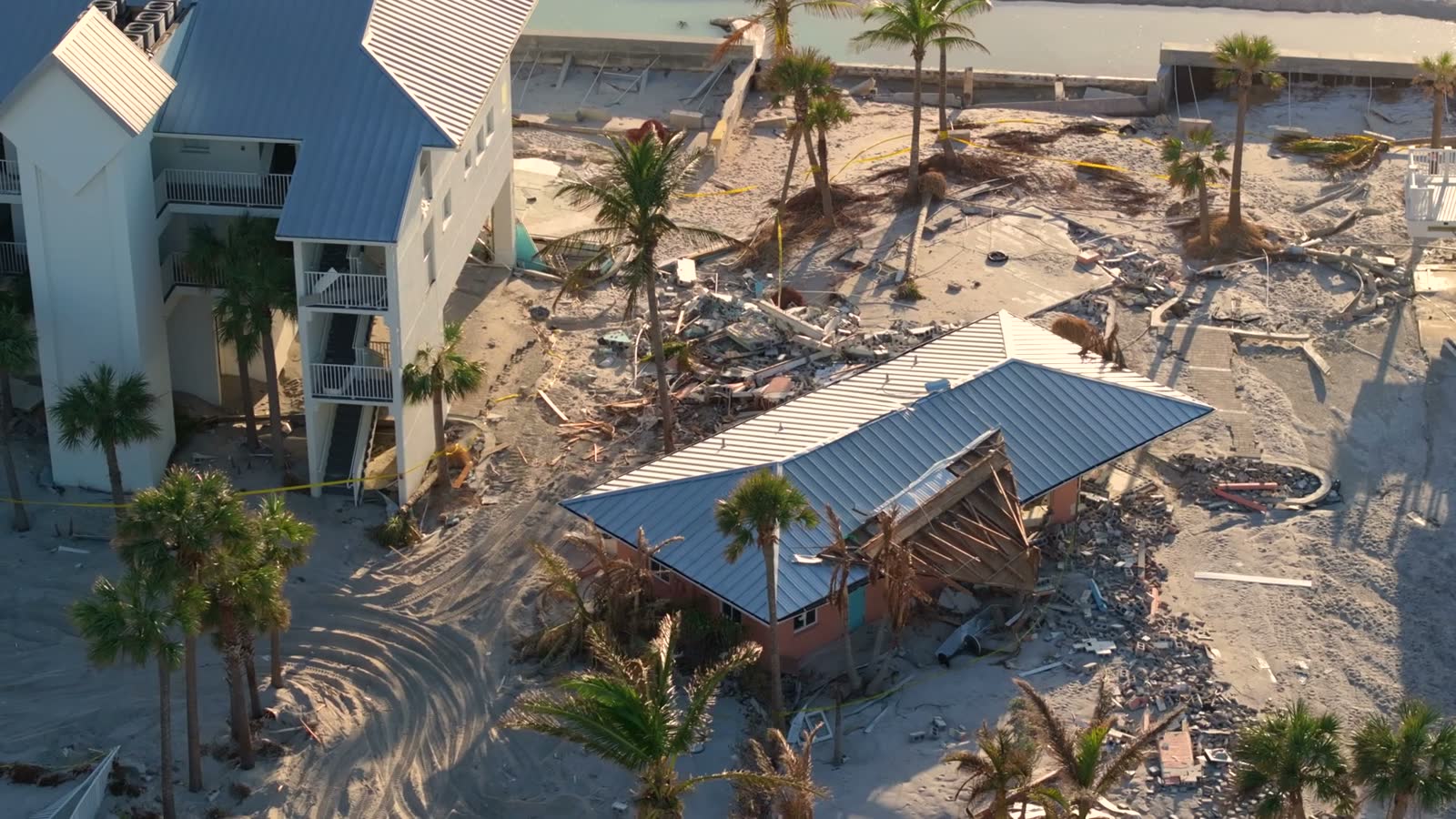
The 2024 season added a third dimension to the causation war: which storm. Helene pushed record surge into the Pinellas barrier islands and Tampa Bay on September 26. Thirteen days later, Milton crossed many of the same neighborhoods with Category 3 wind, 5-10 feet of new surge to the south, and 18+ inches of rain, while Helene's flood debris still sat at the curb.
For a house that took Helene's water and Milton's wind, three questions controlled the payout: which storm caused which damage, which policy (homeowners vs. flood) responds to each, and how many hurricane deductibles apply. Florida's percentage deductible runs per-season in some policy forms and per-storm in others. Flood carriers pointed at Milton's wind; wind carriers pointed at Helene's water; each storm's file blamed the other's.
The aggregate result, per FLOIR's November 2024 data: of 329,000+ residential claims across the two storms, 42 percent were closed without payment, with below-deductible losses and uncovered flood damage the leading cited reasons. The single strongest piece of evidence in the allocation disputes turned out to be anything dated inside the 13-day gap: photos of the property after Helene but before Milton, adjuster inspections, contractor estimates. Owners who documented between the storms could draw the line; owners who couldn't watched both carriers draw it for them.
Building the sequence evidence
Every doctrine above (ACC, concurrent cause, burden of proof) resolves on the same factual question: what did the wind do before the water arrived, and how high did the water actually get? Four public evidence sources answer it, and all four are free.
High-water marks
After every major storm, USGS field crews survey and publish surveyed high-water marks, the official record of how deep the water got at specific coordinates. The Flood Event Viewer maps every mark. A mark near your address establishes the flood line; damage above it is hard to attribute to surge.
Surge inundation maps
NHC's Tropical Cyclone Reports publish peak-inundation figures and maps for every landfall: Ian's 10-15 ft zone, Helene's 15 ft Big Bend inundation. If the official maps show 3 ft of surge on your street and the carrier attributes a second-story loss to flood, the map is your exhibit.
Wind-before-water records
Hurricane-force wind arrives hours before peak surge. ASOS station wind records, radar loops, time-stamped photos and video, security-camera footage, and neighbor accounts establish what the wind had already done before the water rose: the sequence that decides ACC disputes under Corban-line reasoning.
Causation opinions
A structural engineer reads debris fields, failure modes, water lines, and connection failures to allocate damage between wind and water. Carriers hire theirs; you are entitled to yours. In slab cases the engineering report is usually the whole fight.
USGS high-water marks: USGS Flood Event Viewer ↗ · NHC reports and surge maps: NHC Tropical Cyclone Reports ↗ · wind history for your address: our Storm History Lookup.
NFIP claim mechanics vs. private flood
If part of your loss lands in the flood band, understand that an NFIP claim is a different legal animal from a homeowners claim. It runs on federal rules, and the traps are procedural.
The 60-day sworn proof of loss is the trap that has voided more flood claims than any adjuster's opinion. After Sandy, unfiled and late proofs of loss defeated otherwise valid claims wholesale. The one-year federal suit deadline runs from the first written denial of any part of the claim, and courts apply it strictly. And because federal law preempts state remedies, there is no bad-faith leverage against an NFIP carrier: the claim is won on documentation or not at all. Private flood policies, a growing market in Florida, trade the federal backstop for ordinary insurance law: higher limits, ALE, replacement-cost contents, and state-law remedies when the carrier misbehaves.
Florida vs. South Carolina
- Doctrine: concurrent-cause rule under Sebo for policies without ACC wording; ACC clauses enforced where present. The policy text decides.
- Wind claim deadlines: 1 year to notice a new claim, 18 months supplemental; carrier pay-or-deny in 60 days; 5-year contract suit period.
- Surge exposure: the nation's largest. Ian ($112.9B), Helene, Milton all fought surge allocation here.
- Escalation: DFS mediation program, appraisal where the policy provides it, mandatory pre-suit notice post-SB 2-A.
- Doctrine: flood/surge exclusions and ACC clauses generally enforced per policy language; no Sebo-style concurrent-cause default adopted statewide.
- Wind claim deadlines: "prompt" notice per policy; no fixed pay-or-deny statute (reasonableness standard); 3-year contract suit period.
- Surge exposure: coastal. Ian's third landfall at Georgetown pushed surge into the Charleston-to-Myrtle Beach coast; Hugo (1989) remains the benchmark. Inland Helene losses were freshwater flood, almost entirely uninsured.
- Escalation: SC DOI consumer complaint, appraisal, and SC's improper-claims-practices law (S.C. Code § 38-59-20) as the conduct backstop.
Deadlines shown are general rules as of July 2026 and have exceptions: supplemental claims, reopened claims, and policy-specific notice provisions can shorten them. NFIP deadlines are federal and identical in both states. Verify against your policy and current statute.
Surge vs. flood: the questions everyone asks
Is storm surge covered by homeowners insurance?
No. Standard homeowners policies exclude flood, and the exclusion defines flood to include waves, tidal water, and overflow of a body of water, whether or not driven by wind, which is storm surge. Courts, including the Fifth Circuit in Leonard v. Nationwide, have upheld that reading. Surge is covered by flood insurance: an NFIP policy or a private flood policy.
My house took both wind and surge damage. Who pays?
Both policies can owe: the wind (homeowners) policy for wind damage, the flood policy for water damage. The fight is allocation: carriers on each side may attribute damage to the other peril. File both claims promptly, document the sequence of damage, and do not let either carrier close its file based on the other policy's existence.
What is an anti-concurrent-causation (ACC) clause?
Policy language stating that when an excluded peril (flood) contributes to a loss "directly or indirectly" and "regardless of any other cause or event contributing concurrently or in any sequence," the exclusion controls. Courts have enforced ACC clauses, but in Corban v. USAA the Mississippi Supreme Court held they only apply where wind and water act together; wind damage complete before the surge arrived remains covered. Whether your policy even contains ACC wording is the first thing to check.
What if my policy has no ACC clause (Florida)?
In Sebo v. American Home Assurance (Fla. 2016), the Florida Supreme Court applied the concurrent-cause doctrine: where covered and excluded perils combine and no single cause is the sole proximate cause, coverage may exist, unless the policy contains ACC language. Reading the actual exclusion wording in your policy, not the denial letter's summary, is decisive.
The NFIP paid me $250,000 but my loss is bigger. Now what?
The NFIP dwelling cap is $250,000 ($100,000 contents) and it does not pay additional living expenses. Above the caps, recovery comes from: the wind policy for any wind-caused portion of the loss, excess/private flood coverage if you bought it, and otherwise FEMA Individual Assistance grants and SBA disaster loans. This gap is why the wind-vs-water allocation fight matters even for insured flood losses.
How long do I have to fight an NFIP flood denial?
NFIP deadlines are federal and unforgiving: a signed, sworn proof of loss within 60 days of the loss (FEMA sometimes extends it after major storms), a FEMA appeal within 60 days of a written denial, and suit in federal district court within one year of the first written denial, not the usual state contract period. State bad-faith remedies do not apply to NFIP claims.
The same adjuster handled my wind claim and my flood claim. Is that allowed?
Often, yes. Most NFIP policies are serviced by private "Write Your Own" carriers, which can mean one company adjusting both policies on one house. Katrina-era litigation and congressional inquiry focused on the incentive to steer damage toward the federally backed flood policy and away from the carrier's own wind policy. You are entitled to demand both complete claim files, including engineering reports.
- FINDLAW Leonard v. Nationwide Mut. Ins. Co., 499 F.3d 419 (5th Cir. 2007) ↗
- FINDLAW Corban v. United Servs. Auto. Ass'n, 20 So. 3d 601 (Miss. 2009) ↗
- JUSTIA Sebo v. American Home Assurance Co., 208 So. 3d 694 (Fla. 2016) ↗
- NOAA / NHC NHC Tropical Cyclone Report, Hurricane Katrina (PDF) ↗
- NOAA / NHC NHC Tropical Cyclone Report, Hurricane Ian (PDF) ↗
- US GAO GAO-07-169, wind-vs-water claims after Katrina ↗
- FEMA NFIP Claims Handbook (PDF) ↗
- FEMA / FLOODSMART Appeal an NFIP flood claim ↗
- FLOIR FLOIR Hurricane Ian catastrophe claims data ↗
- FLOIR FLOIR Hurricane Milton catastrophe claims data ↗
- USGS USGS Flood Event Viewer, high-water marks ↗
- NEWS-PRESS / YAHOO Ian wind-vs-water jury verdicts, Lee County ↗
Not legal advice; consult an attorney about your specific claim. FLOIR claim statistics as reported in the agency's catastrophe data releases.
Surge, flood, and wind are three separate coverages for one loss
The word on the denial decides who pays. Storm surge and rising water are covered by flood insurance, NFIP or private, not by a homeowners policy; wind and wind-driven rain are covered by the homeowners policy, not by flood. When a hurricane brings both, carriers assign as much of the loss as they can to the coverage you did not buy, so the wind-water split is the most valuable finding in a coastal claim.
Prove the sequence and the height. Wind damage done before the water arrived is a homeowners loss, so document the high-water line, the debris direction, and what survived above the water. A storm surge claim and a flood claim run on separate adjusters and deductibles; NFIP flood also carries its own proof-of-loss deadline, shorter than the state windstorm one, and missing one does not extend the other. Damage above the surge line the carrier still calls flood is often wind-driven rain reclassified to avoid payment, so photograph everything before cleanup with a documented protocol. A whole-loss denial on concurrent-causation grounds can cross into bad faith; the free claim review below sorts which dollars are wind and which are water.
Carrier says it was all surge? Make them prove it.
Upload the denial letter, your photos, and any engineering report. You'll get a straight answer on whether the water-exclusion argument holds against the sequence evidence, and what the wind side of your claim may still be worth.

 HURRICANELAW.PRO
 A comprehensive property-insurance claim resource for policyholders: denied and underpaid claims, coverage and bad-faith law, storm dossiers, carrier profiles, city guides, and the complete claims playbook. Florida and South Carolina.
▸ SEE THE FULL SITE MAP →Coverage summaries, policy-language quotations, dollar figures, deadlines, and chart examples throughout this site are general information based on typical or standard policy forms and are illustrative only: they are not a quote, a guarantee of coverage, or a promise of any outcome. Every insurance policy is different: your own policy, endorsements, and state law control, so read your policy and confirm current statutes. Weather imagery courtesy of NOAA, the National Hurricane Center, and the National Weather Service. Legal services are provided by Halversen Law. Nothing on this site is legal advice; consult an attorney about your specific claim.
Legal matters are handled by Halversen Law, a law firm licensed in Florida and South Carolina.